Basic Guitar Chords for Beginners
The Purpose of this Guide
Learning how to play guitar starts with learning the chords. In this article, we'll focus on learning each of the basic guitar chords that you eventually have to know like the back of your hand.
Goals for Learning the Basic Guitar Chords
From day one, beginner guitarists should focus on getting their open chords to the point where all the strings sound clean and pure sounding, as it is the foundation for being able to play popular songs on the guitar.
Overview of Guitar Chords for Beginner Guitar
So, if you've never even touched a guitar before, what exactly is a guitar chord? Well, simply put, it's when you put your fingers on multiple strings and play them at the same time.
If you just put, say, your index finger on a string and pressed down and only played the one string, you're only playing a note. Multiple notes played at the same time equals a guitar chord.
Now, guitar chords are the essential building block for playing guitar because that's how we play songs. String together a few chords with a basic strum, and all of a sudden you have a song that sounds multi-dimensional.
Of course, there are all kinds of guitar chords to choose from, but the most useful, whether you are a beginner or advanced, are the basic open chords. Open chords are called as such because they make use of open strings, meaning strings that you don't press down to make a sound.
Compare this to barre chords, which in their basic state, make you press down all the strings in order to play.
In general, barre chords are more advanced (and harder) than the average beginner guitar player needs to know, but they're not usually that necessary either.
Of course, eventually, you'll have to know some barre chord principles, as it's just part of the process.
Article continues past the image.
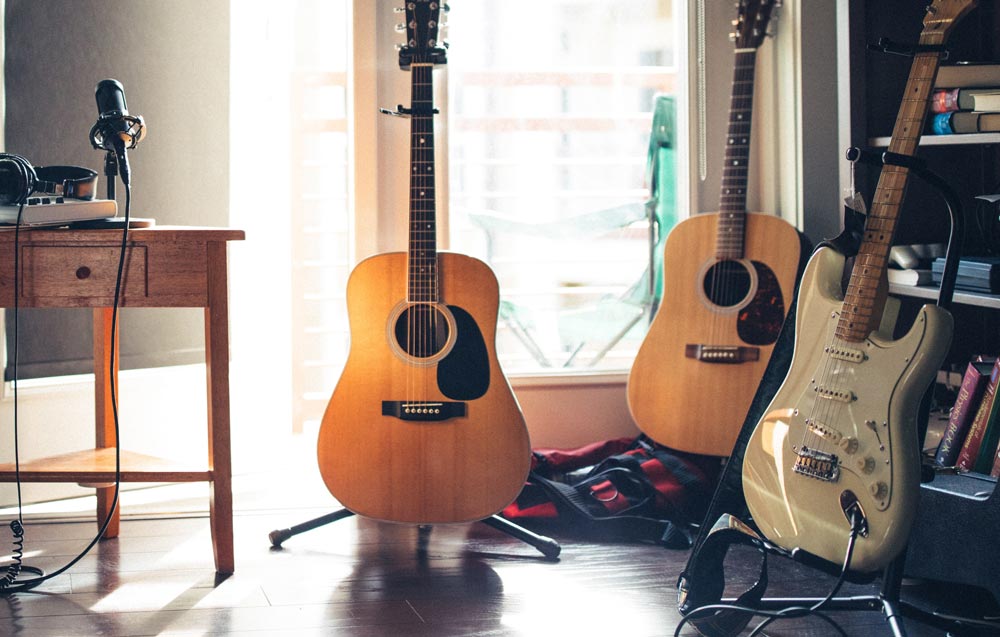
Open Chords to Start With
The first set of guitar chords that everyone usually starts contains the G, C and D major chords and the E minor chord, which is usually written as Em. In general, major chords sound bright and kind of happy, while minor chords sound dark and somewhat sad.
Tips for playing the G major chord
There are at least five ways to play a basic open G chord, and to be honest, any one of them will work fine. It's just one of those chords that as you improve, you develop new ways of playing it out of necessity.
Probably the most common way to play a G chord is to put your pinky finger on the 3rd fret of the high E string, your middle finger on the 2nd fret of the A string and your ring finger on the 3rd fret of the low G string.
For a younger kid, or if you're a beginner who really wants to push the envelope, you can just put your ring finger on the 3rd fret of the high E string, and make sure to only strum the four high strings, D, G, B and E.
The C and D chords
The C chord and D chord are much more straightforward, as there's simply fewer less conventional ways of playing them. To play the C chord, it's index finger on the 1st fret of the B string, middle finger on the 2nd fret of the D string and ring finger on the 3rd fret of the A string.
The D chord is index finger on the 2nd fret of the G string, the middle finger on the 2nd fret of the high E string and the ring finger on the 3rd fret of the B string. For the D major chord, only strum the four high strings.
E Minor Chord (Em) and Minor Chord Basics
Then there's the Em chord. You'll also see this played a couple different ways, but one of the most common, and perhaps easiest for beginners, is by putting your middle finger on the 2nd fret of the A string and your ring finger also on the 2nd fret, but this time on the D string.
Note that you don't want to confuse this with the E major chord, which is a happier sounding chord that won't mix as well with the G, C and D major chords.
Phase 2 of Learning the Basic Guitar Chords
Ok, after you're learned how to get clear sounding notes on all of the strings of your first four guitar chords, it's time to start branching out and learning a few more.
The next ones to learn, roughly in this order is A minor (Am), the A major chord, E major, D minor (Dm), B7, E7 and A7.
Strumming the Beginner Guitar Chords
To connect the chords together, you want to find basic strumming patterns that help you switch from one shape to another. To get started, think of the 2 easiest chords you know. Start counting to four on a loop. Each time you get to 1, rock back and forth between the two chords.
So, if you chose the G chord and D chord, play G on beat 1, count 2, 3 and 4 and then switch to D. Work up to downstrokes on all the beats and then add more chords.
From there, go out and find other familiar patterns online.
Using Chords In Popular Songs
The best way to learn these chords is to find the chord charts for each one, or look it up online. Once you have the basic fingerings down, you should start to find song sheets that have the chords over the top of the lyrics, and start learning your favorite songs.
The more songs you play, the more you will encounter all the basic guitar chords in a variety of different contexts.
Trust me, if you just write down chord progressions with the same chords in them all the time, you'll inevitably find yourself in a rut.
Barre Chords: They're Inevitable
Definitely more sooner than later, you will run across the need to play an F chord, which is usually most beginner guitar players' first encounter with barre chord principles.
A barre chord basically requires you to play multiple strings on the same fret with only one finger. Of course, in the beginning, this is almost impossible, and really just takes practice to gain the strength to do it.
So, here's how to play the F major chord. Index finger plays both the B and high E strings on the 1st fret. Middle finger plays the 2nd fret of the G string and the ring finger plays the 3rd fret of the D string.
The F chord is really every guitarist's rite of passage, and there are no ways around it. Just get through it, and you'll appreciate the hard work later.
Many Songs Use the Same Chords
The good thing is that there are many resources for beginner guitar chords, how to play them right, how to troubleshoot mistakes, and even better, how to play songs.
The thing is, most of your favorite songs use around the same fifteen chords, so time and again, you'll just have to keep employing the ones you're learning.
A Basic Practice Plan
Look, guitar is hard, and for the first year or so, your basic chords are going to sound first, bad, then mediocre. But if you keep at it and focus on the other basic guitar skills, such as strumming, learning how to use a capo, learning some pentatonic scales, and even singing, the chords will come.
But it does take patience and a good plan of attack for practicing. A tried and true method of improving your guitar playing comes from a commitment to play guitar for 30 minutes everyday, no matter what. The more you play the better you'll get, and there's just not really a shortcut, unfortunately.
Besides, one day, you'll remember fondly the days you were stuck on the basic guitar chords when you're banging your head against the wall to try to do something else on the instrument.
FEATURED MUSIC
Joshua Espinosa
Americaña

The latest album from the founder of Approachable Music.
Listen Now